Rogue Ocean Waves
Modeling extreme ocean waves through the Nonlinear Schrödinger Equation and Gerstner wave theory
NLSE | Gerstner
Frameworks
Split-Step FFT
PDE Solver
Perturbation Analysis
Key Study
The Problem
Rogue waves, ocean waves exceeding 2.5x the surrounding sea state, appear without warning and pose catastrophic risks to ships and offshore structures. Once dismissed as maritime folklore, their existence was confirmed by the 1995 Draupner wave event, and tragedies like the loss of MS München (1978) underscore their destructive potential. Traditional linear wave models fundamentally fail to predict these extreme events. Understanding their nonlinear formation mechanisms is essential for developing predictive tools that could protect lives, vessels, and critical maritime infrastructure.
Approach
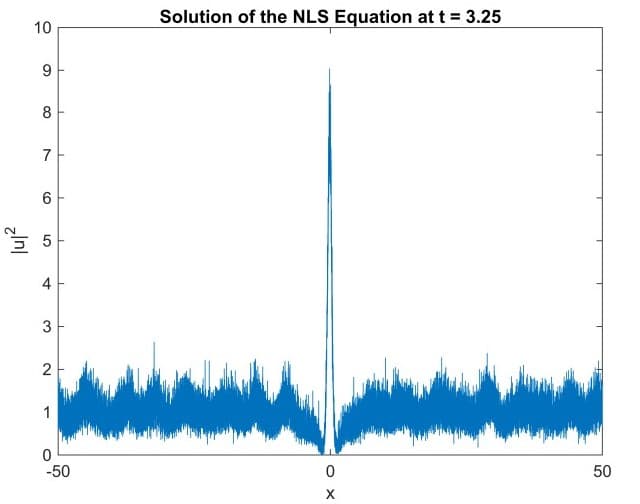
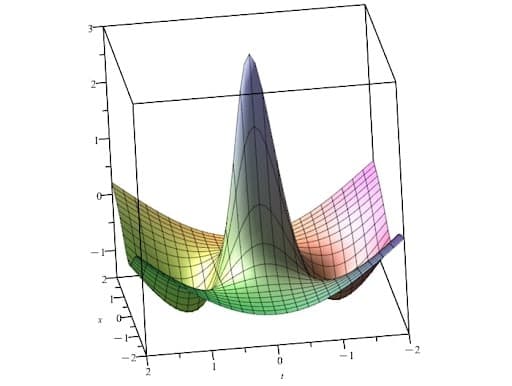
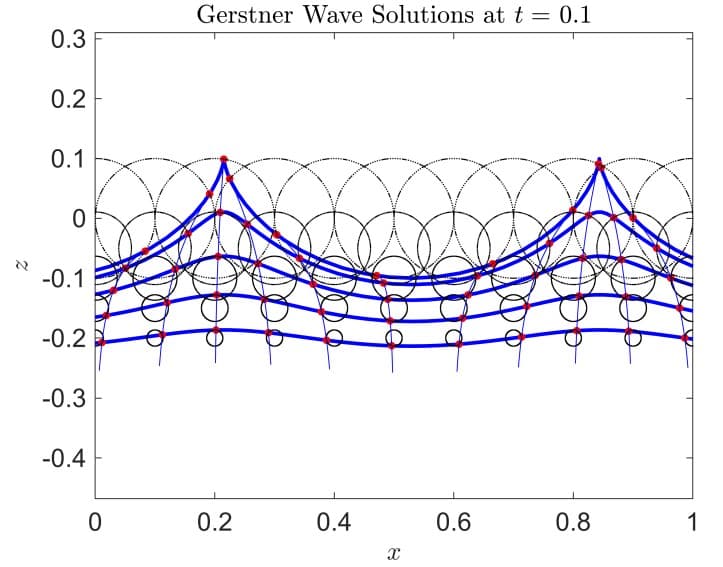
Co-authored with Constantino Mangone at the University of North Carolina Wilmington, this research attacked the problem from two complementary mathematical frameworks. We implemented the Split-Step Fourier Method (SSFM) to numerically solve the Nonlinear Schrödinger Equation (NLSE), separating it into nonlinear and linear components handled via exponential operators and Fast Fourier Transform (FFT). The NLSE governs wave envelope evolution in dispersive, nonlinear media and is key to modeling modulation instability, the mechanism through which small perturbations grow into extreme amplitude events. We numerically reproduced the Peregrine soliton, a known exact breather solution that models how extreme waves can emerge suddenly from calm seas, then introduced realistic noise perturbations to probe sensitivity in regimes inaccessible to closed-form analysis. Separately, we modeled Gerstner wave dynamics using Lagrangian coordinates and parametric equations, implementing Gerstner's transformation to trace the trochoidal particle orbits at varying depths. Gerstner waves provide exact solutions to the full Euler equations for deep-water gravity waves, capturing the physical particle motion that the NLSE envelope approach does not address.
Results
Successfully reproduced the Peregrine soliton in both 2D cross-section and 3D spatiotemporal evolution, capturing the characteristic amplitude peak (~3x background) that emerges from and returns to a uniform wave field. Noise-perturbed simulations demonstrated how small disturbances can cascade into extreme wave events, consistent with observed ocean conditions. Gerstner wave simulations captured the trochoidal profiles and circular particle orbits that distinguish nonlinear deep-water wave motion from linear approximations. The dual-framework approach provided complementary insights: NLSE for predicting rogue wave emergence via modulation instability, Gerstner for understanding the underlying physical particle dynamics. Findings were presented in a conference setting, and the paper identifies machine learning integration with real-time oceanographic data as a promising next step for operational rogue wave prediction.
Figures